
Gender Jeopardy: A Game of Trans Resilience
The Gender Jeopardy boardgame is the product of a collaboration between GENERATE, Sanggar Seroja – a collective of transgender women living in Kampung Duri, Jakarta, boardgame designer Mahawira Dillon, and illustrator Kartika Luthfiyah. Gender Jeopardy translates lived knowledge into a creative tool for trying to better understand intersectional disadvantage in practice, build empathy, and transform attitudes and practices at grassroots and policy levels.
Sanggar Seroja was founded in 2016 by two transgender women who had more than 20 years of experience in the arts, particularly dance, lenong (traditional theatre of Betawi people in Jakarta) and theatre. Bringing together a group of art lovers, Sanggar Seroja specialises in theatre performances at festivals and cultural events, drawing on traditional and contemporary forms of performance to generate income while forming a hub for social support and solidarity for transgender women in the Kampung Duri; which has, since the 1970s, provided a refuge for queer people seeking livelihoods and community in Jakarta.
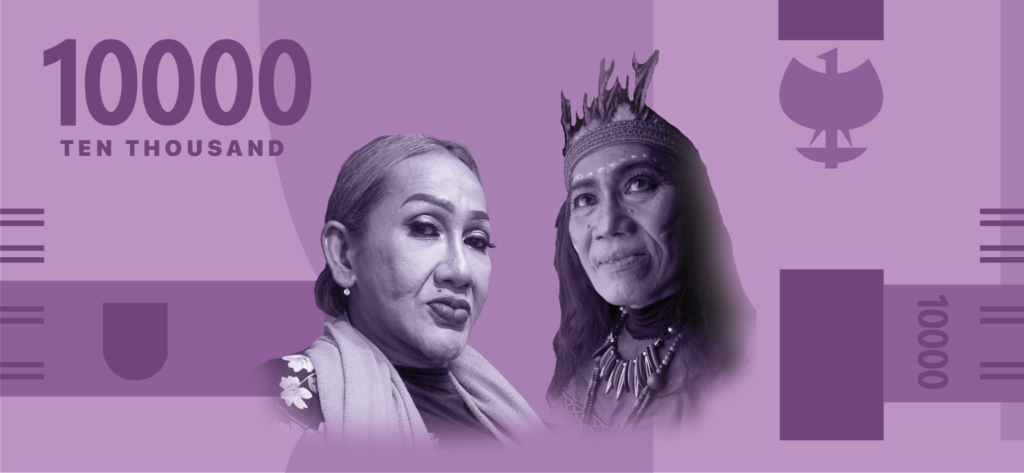
Our vision was for a board game that could immerse players in the intersectional layering of disadvantages faced by transgender women living in Indonesia. It addresses how gender works through all aspects of life to deliver and compound socioeconomic, physical, and psychological harms. Gender Jeopardy explores the unique vulnerabilities of transgender women to climate change, pollution, and disasters, as well as social stigma and exclusion and precarious livelihoods. At the same time, it seeks to spotlight the creativity, resilience and leadership of transgender women in the face of this multiple marginalisation.
The 160 cards that make up the game – which you can play as a cisgender man or woman or transgender woman – present a working analysis of multiple overlapping disadvantages and risks, and how they can (or not) be navigated through different social support systems. From livelihood choices and salaries, to the impacts of different crises – both generalised and specific to the community – the player gets to experience what life is like to live in the shoes of a transgender woman. The crises represented on the cards, such as health crises, violent discrimination, family rejection, precarious livelihoods, pollution, and environmental disasters, are drawn directly from the lived experiences of our collaborators.
The game aims to help players to better understand how gender inequalities and discrimination intersect with broader structural forces (including socio-economic justice, education, environmental justice – pollution, water and sanitation, poor quality housing etc, health and so on) to limit the capacities of certain communities, particularly sexual and gender diverse people, to respond to climate change and disasters. In this way, it highlights broader ways in which gender norms, practices and power exacerbates the vulnerabilities of marginalised groups, and disproportionately increases their environmental burdens.
The game has been played at GENERATE events that bring communities, local leaders and government staff, and representatives from human rights, gender equality and environmental and climate change organisations into conversation with transgender women who were involved in the project. In turn they can then speak directly to their experiences and share first-hand accounts of the crises represented on the game cards. This combination of game-playing and personal voicing of vulnerabilities has been incredibly powerful and all participants have recorded being significantly moved and pledging to change their own practices and attitudes moving forward. Engagement in the project has also led to new programmes and training on gender and social inclusion at key national environmental organisations.
The boardgame has been printed in both English and Bahasa Indonesia and relates to our Trans Superheroes for Climate project.
Trans Superheroes for Climate
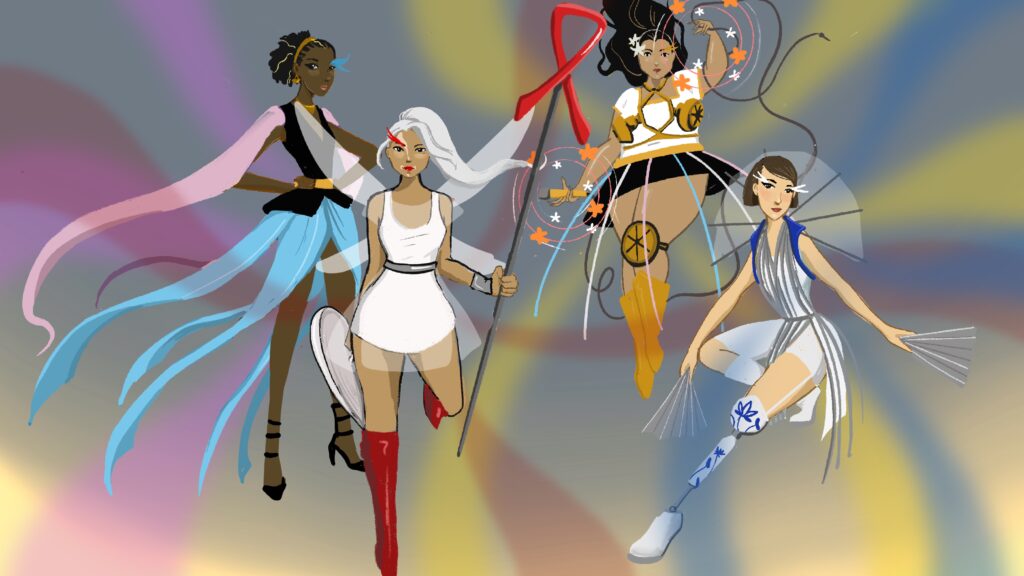
The Trans Superhero Perubahan Iklim project introduces four new superheroes: Dana, Asih, Vei Lan and Tara. Together, they overcome lifetimes of social exclusion and marginalisation to lead the fight for social, gender, economic, health and environmental justice for all.
In collaboration with Sanggar Seroja, our vision was for a project to challenge the multiple marginalisation, disproportionate environmental burdens, and widespread discrimination against sexual and gender-diverse communities across Indonesia. By foregrounding the creativity, resilience and leadership of transgender women we aimed to co-design a project that would promote social, gender, economic and environmental justice.
Sanggar Seroja was founded in 2016 by two transgender women who had more than 20 years of experience in the arts, particularly dance, lenong (traditional theatre of Betawi people in Jakarta) and theatre. Bringing together a group of art lovers, Sanggar Seroja specialises in theatre performances at festivals and cultural events, drawing on traditional and contemporary forms of performance to generate income while forming a hub for social support and solidarity for transgender women in the congested and polluted Kampung Duri, a sub-district in West Jakarta and one of the most densely populated neighbourhoods in South-East Asia; which has, since the 1970s, provided a refuge for queer people seeking livelihoods and community in Jakarta.
The Trans Superheroes Perubahan Iklim embody a series of nested interventions that are simultaneously heroic characters (and role models), sustainable (and fabulous) fashion, socioeconomic empowerment and sustainable livelihoods, gender and climate activism, and collaborative knowledge production. It began with training for Sanggar Seroja members in advocacy, human rights and paralegal processes, grant management, and livelihood skills including harvesting eco-enzymes from organic waste products and using (and selling) these for medicinal, beauty, and household cleaning products. These skills training needs and the facilitators who delivered them were all identified by Sanggar Seroja.
On 23rd April 2022 the superheroes were launched at a street Karnaval in the Kampung Duri. The superheroes wore elaborate fantastical costumes created out of recycled materials (and common waste) by fashion designers and artists including Omar Al Fahd, Kartika Jahja, Muthiara Rievana, and Mariana. The Karnival was supported by local authorities and involved a parade down the main road. The public responded with support, sharing appreciation towards the transwomen community for leading environmental initiatives and including the wider population in their festivities.
The Characters
Dana
Asih
Vei Lan
Tara
The Comic
In 2023 we began co-developing a comic that would weave together the lived experiences of transwomen and visualise an alternative inclusive and equitable future that is led by and enacted by these superheroes. The comic was brought to life by illustrator Leka Putra, and scriptwriter Yara, and the story was developed in collaboration between GENERATE and Sanggar Seroja.
While the superhero characters of Dana, Asih, Vei Lan and Tara are fictional, their life stories are inspired by real-life experiences shared with GENERATE by transgender women living across Indonesia between 2022-2023. They blur the boundary between research, art, and action – the characters are fictional, yet they engage in real-world transformation.
They offer a radical and visual retelling of the dominant climate narrative that women, especially those in the so-called ‘Global South’, are victims of climate change. Our superheroes draw on their beauty and femininity, creativity, and strength to highlight the disproportionate impacts of climate change and environmental injustice on women and sexual and gender-diverse people in Indonesia through visualising an alternative future: one of hope, inclusion, and power. Arts are used to promote leadership, not victimhood, to advance our understanding of how social norms can be challenged and reimagined.
As knowledge is co-produced it is put into service. The superheroes have shared research with academics and activists as well as policymakers, generated increased social acceptance in their local neighbourhoods, and promoted different ways of being and belonging that transcend the prisons of patriarchal and heteronormative orders. They offer their own community, allies, and detractors alike a new blueprint for relating to each other and leading work towards social, environmental and climate justice.
It has been printed in both Bahasa Indonesia and English.
(Text shared here is borrowed from our 2023 article: Hanya ada Satu Kata: Lawan! On decolonising and building a mutual collaborative research practice on gender and climate change, Gender & Development, 31:2-3, 575-595. link.)