
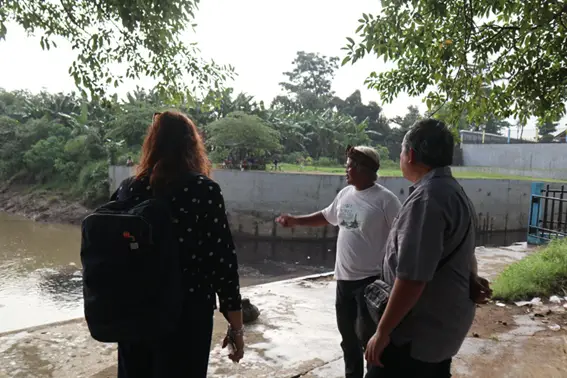
Students from the Interior Design Department at Universitas Sebelas Maret, under the guidance of Mr. Andi Setiawan, S.Sn., M.Ds. (Lecturer in Interior Design, Universitas Sebelas Maret), and Dr. Katie McQuaid (Associate Professor of Gender and Climate, University of Leeds), collaborated on a visit to Kampung Sewu, Surakarta, to hold a Workshop on Regional Planning and Reconstruction of Traditional Boat Craftsmanship (May 22-23, 2025).
Kampung Sewu, located on the banks of the Bengawan Solo River, is a place where the rich history and culture of the river meet the very real environmental challenge of recurring floods. When we first set foot in this village, we were warmly welcomed by the residents—a hospitality that strengthened our resolve to listen, learn, and collaborate with them. Historically, Kampung Sewu has experienced major floods numerous times over the decades. In the past, the riverbanks were still natural and unprotected by embankments, so houses were built very close to the river itself. This situation was compounded by informal settlements along the banks, areas often characterized by overgrown vegetation and accumulated waste. These settlements not only worsened environmental conditions but also damaged the river’s ecosystem, which should have served as a natural buffer for the community.
When the Bengawan Solo River overflows, the surrounding settlements inevitably flood. This recurring challenge gradually raised awareness among Kampung Sewu’s residents about the importance of protecting and restoring their environment. Over time, the village has undergone gradual revitalization. Relocation of homes in flood-prone zones and the construction of embankments marked critical initial steps.
This transformation has brought significant change. Once perceived as a neglected and impoverished area, Kampung Sewu is slowly emerging as a vibrant cultural village. The previously closed-off riverbanks have been opened up as green open spaces for the community to enjoy. This revitalization has sparked a renewed spirit among residents to continue building a more comfortable neighborhood that can accommodate a variety of social and cultural activities. It was this spirit that brought us to Kampung Sewu—to support the community in shaping ideas for spatial planning.
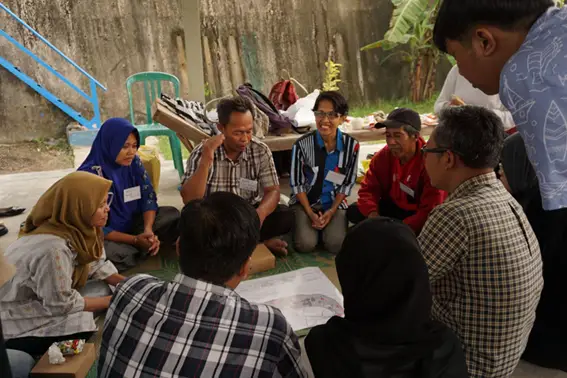
Our spatial planning workshop took place in a pavilion situated on the river embankment. Together with residents, we documented their hopes and aspirations for their living environment. We aimed to co-design solutions that were not only technically sound but deeply rooted in local wisdom and community values. A key desire was to utilize the green open spaces along the riverbanks as safe, communal areas that would not disrupt the river’s ecosystem.
The workshop sparked lively and collaborative discussions, generating creative ideas such as designing a children’s playground, a jogging track, and even a goat pen to support local livelihoods. We assisted in visualizing these ideas to help the community better imagine their future environment. Throughout these conversations, residents shared stories of the past—their longing to revive traditions like the Apem Sewu ceremony, the traditional children’s game “Empu,” and their pride in the boat-making craft that once defined Kampung Sewu.
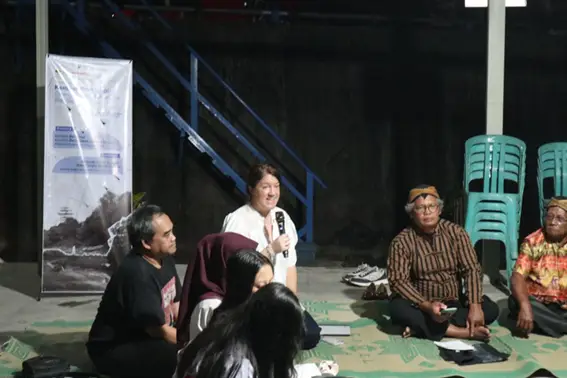
These stories deeply resonated with us. Inspired, we organized a Workshop on Boat Craft Reconstruction. Here, we had the privilege of hearing firsthand from the boat artisans themselves. They recounted the intricate process of boat-making, the symbolism behind the designs and ornaments, and how these boats historically symbolized the community’s resilience amid floods and river currents.
Boat-making was once a thriving craft and a cornerstone of Kampung Sewu’s economy. Beyond crafting boats, residents also operated river crossing services using their handmade vessels. The artisans spoke with pride about the quality of their work, noting that there were no recorded failures in production throughout the craft’s history.
Initially, we assumed that boat production took place in a dedicated workshop or factory. However, we discovered that the entire process was traditionally carried out along the riverbank, leaving no physical structures to document today. Despite this, the collective spirit to preserve this rich history remains strong. Through illustrations and detailed notes, we strive to reconstruct these shared memories before they fade away.
In addition to cultural preservation, the community has taken practical steps to mitigate flooding by planting vetiver grass along the riverbanks. This plant’s deep roots help prevent soil erosion and stabilize the riverbanks against floodwaters. We were also shown fruit orchards cultivated by residents along the banks, which now contribute to Kampung Sewu’s local economy. These efforts, though modest, reflect the community’s resilience and their desire to live in harmony with the river.
This workshop was more than spatial planning or craft preservation—it was about rebuilding the relationship between people, culture, and nature. Through this process, we learned that community resilience is not only about physical infrastructure but also about the power of storytelling, collective memory, and intergenerational collaboration.Kampung Sewu teaches us that the river is not merely a threat but a vital source of life and identity. Through this collaboration, we hope Kampung Sewu will rise again—not only as a flood-resilient area but as a thriving center of culture and living heritage.
Authors:
Nazira Ulfah
Aurellia Farah